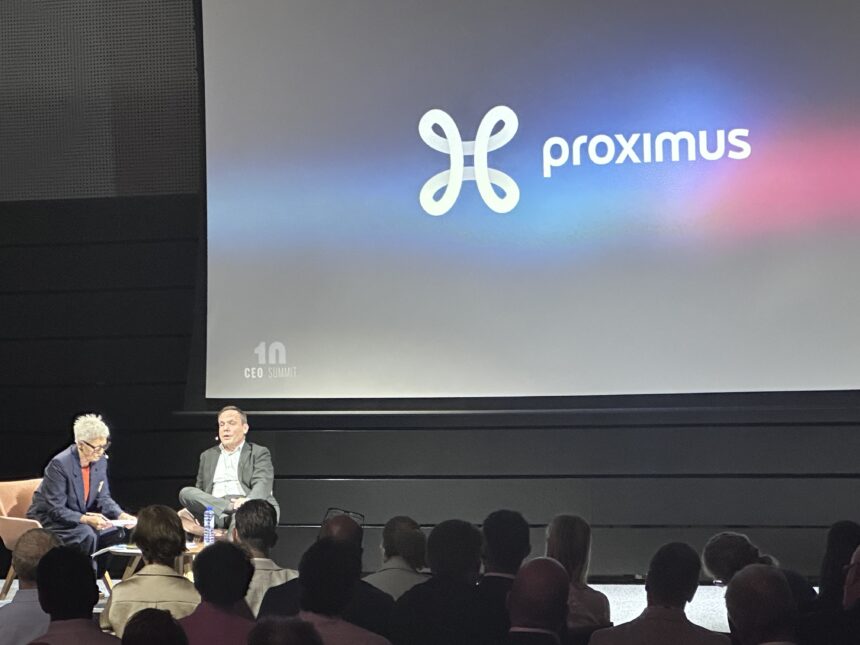
‘Proximus is too financially driven. It was the finance people who were in charge here.” That is what Proximus CEO Stijn Bijnens said at the CEO Summit in Brussels. ‘Decisions were based on NPV (Net Present Value, a financial metric used to determine whether an investment or project is profitable). 45 million NPV here, 15 million NPV there… Everyone will recognise this. My theory is that 80 per cent of those NPV studies are reverse-engineered to support the decision someone actually wants to make anyway. So when someone comes to me for a decision, I say: ‘What would you do if it were your own money?’ Then you see them thinking, and they come back a little later. What I’m trying to do is give people more self-confidence so they can make much better decisions. And the closer you are to the client, the closer you are to the problem, the better your decisions will be’, says Bijnens.
‘It might sound a bit shocking, but there are a few terms I really can’t stand. I don’t like hearing “NPV”, I don’t like hearing “operating model”, I don’t like hearing “transformation programme”. I don’t like hearing “processes”.
‘Three months after my appointment, the Board of Directors asked me for a five-year plan. I’m not in favour of that sort of thing, but I did it anyway. Then you have to give it a name. It became “Amplify” because that word is set to become important in the coming years. It’s an amplifier, like in music. Less input, more output. Many companies – certainly Proximus, given the competitive environment – will have to do more with fewer people, less CapEx and fewer resources. That’s the reality.’
On the question of attracting talent within the company: ‘Proximus has too much talent. But young people are going to find it tough. In the past, they’d get a nice car and a good salary straight away. Now they’ll have to fight for it. AI will have an impact on that. The easiest knowledge-based jobs are at the bottom of the ladder. But you do need young people because their minds aren’t hard-wired yet. I tell young people at Proximus that they shouldn’t follow the processes if it’s better for the customer. It has to be legal, of course, but apart from that…’
A few more notable quotes:
– ‘Ah, those discussions about the matrix and the operating model. If you even have to draw up a job description, things are already going wrong.’
– ‘The HR manager will play a crucial role. Which tasks am I going to give the payroll, and which ones will be handled by AI agents?’
– ‘A great many AI pilot schemes are more of a ‘me too’ story. So you might ask yourself: is this really critical? Is this actually going to change my customer’s life?’
– ‘Hundreds of people have congratulated me on my appointment. “That won’t be easy with the politics.” Let me clear up a misunderstanding. There’s no politics at Proximus. Internally, of course, there is.’
– ‘What has shaped my approach? Not 800 scientific studies. Rather, 400 mistakes, 200 stories and 200 anecdotes.’
– ‘If you really want to change something within a company, it’s going to take at least three years.’
– Sovereignty is the talk of the town, along with AI. But I’m no expert. I don’t think your entire technology sector should become European. I don’t think that’s possible either. We need to restore a better balance. Back then, we had to remove all Chinese equipment from the network. That cost us 200 million euros…’
– I don’t understand the world today. I was right in the thick of the dotcom boom and thought, ‘I don’t understood this either’, and then came the dotcom crash. What’s happening now is, of course, on a much larger scale, and you’ve got loads of Wall Street gurus – who are usually 26-year-old Goldman Sachs analysts with an IQ of 160 – saying that there’s absolutely nothing wrong. We’re keeping our distance from all that.’
– On the AI factory (infrastructure for the management and automation of AI): ‘These are data centres full of NVIDIA boxes that are obsolete after two years and aren’t making any money today. It’s not a sustainable 50-year investment like fibre optics or a nuclear power station.’
– On the obligation for telecoms operators to always inform their customers about a cheaper subscription: ‘If, as a customer, you go to Delhaize or Carrefour and pick up a packet of a particular brand of pasta, should someone at the till tell you that you’d be better off choosing a generic product?’
– ‘In the US, they make decisions more quickly. We can learn something from that. Here, people just keep arguing and citing figures. My mentor always said: the best statistics are the ones you’ve faked yourself.’