
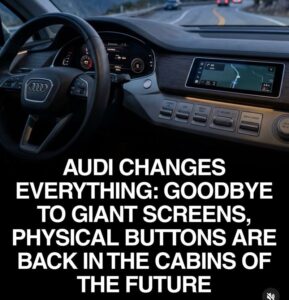
Apparently, Audi has “changed everything.”
Not by making the car substantially smarter, more autonomous, more connected or more capable of learning. No, the great breakthrough is that several physical buttons have returned to the dashboard.
Buttons
The future, it seems, looks suspiciously like 2007, except with better leather.
Now, there is nothing wrong with a well-designed physical control. A volume knob that can be found without taking your eyes off the road is infinitely preferable to navigating three menus, accepting a privacy statement and creating an Audi ID just to lower the temperature. The problem is not the button. The problem is presenting the button as a vision of the future.
It suggests that the designer has misunderstood what is happening to the car.
We are not merely moving from buttons to screens. We are moving from fixed machines to software-defined systems. A physical button performs the function decided upon when the dashboard was designed. A screen can change, learn, adapt and disappear when it is no longer needed. It can become a navigation system, entertainment centre, office, communications platform or control interface for functions that did not even exist when the car left the factory.
And ultimately, in an autonomous vehicle, the entire traditional dashboard becomes questionable. The steering wheel, instrument cluster and carefully machined “drive mode” button are all relics of the period in which humans had to operate the machine themselves.
Nokia once made extremely good buttons too
Its engineers knew precisely how much resistance a key should provide. Its phones were robust, reliable and beautifully optimised for making calls. Then Apple arrived with a device that was objectively worse at being a traditional telephone in several respects. It was fragile, expensive and lacked a proper keyboard.
Nokia looked at it and saw a bad phone.
Apple saw that the phone was about to stop being a phone.
That is the lesson Audi appears to be missing. Tesla and the new Chinese carmakers are not trying to design better dashboards. They are redefining the car as a computer, an intelligent device, an energy node, an entertainment environment and eventually a robot on wheels. The screen is not there because designers have a childish fascination with large pieces of glass. It is there because software needs a flexible interface.
Audi, meanwhile, has discovered the reassuring click of yesterday.
Nostalgia is comforting. It reminds customers of a time when Audi was ahead and Nokia still mattered.
But nostalgia is what companies reach for when vision runs out and they no longer know what to do tomorrow, so they lovingly redesign yesterday. Unfortunately, the next generation of buyers is not going back. Once 10% has moved to big screens, software and autonomy, the tipping point has been reached.
And that 10% was yesterday.
Rik Vera is an author, futurologist, business philosopher, coach and above all a very inspiring keynote speaker. He looks at companies and organisations from his unique and surprisingly broad perspective and makes it clear to them how they can continue to be relevant in the ever digitising society of the future. He likes to challenge them to distinguish themselves within and even outside of their industry.