
Those who have been following me for a while know that I warn against the “demarketing” of the regular police and the emergence of digital platforms in “safety & security”! This weekend, my attention was drawn to an article in “De Gentenaar” (Caught speeding? The police will immediately check your insurance). in which, once again, something fundamental is happening quietly (?) in our security landscape, with private databases directing police work.
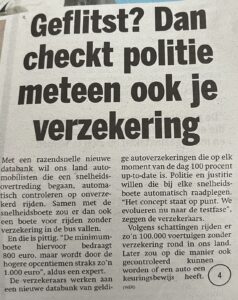
Increasingly, private sectors, insurers, banks and technology companies are building databases that are becoming/are essential to the work of the police and the judiciary. The police are given access, can consult them and can work faster. Efficient, logical, modern, but we rarely ask the real question.
Who owns the data on which security is built today?
When crucial information about vehicles, fraud, transactions or digital traces is managed by private organisations, a new “security model” emerges. The state still enforces the law, but the information infrastructure on which it relies is shifting into private hands. Is that a bad thing? Not necessarily, but it does change the balance.
In the philosophy of ‘The new police’, we are moving towards a network model of security in which Police is no longer the only actor. Security arises in an ecosystem of public and private players.
So the real question is not whether we collaborate with private data sources, but who ultimately controls the security data in our society?
When the government becomes dependent on databases that it does not manage, develop or control itself, a new area of tension arises in the constitutional state.
The monopoly on the use of force is not being privatised, but perhaps the information on which that monopoly is based is?
And data is power, as I learned years ago from my friends at Nexxworks ;-)
That is why the crucial challenge for the coming period (although how long have we been waiting already!!) is not technology, but “governance”.
How do we ensure that cooperation with private data becomes stronger, accelerating innovation without eroding public control over security?
Or are we unconsciously building a security architecture of which “the state” is merely a user?
I am curious to hear how others view this, especially my (former) colleagues and leaders in justice, policy and technology.
Steven De Smet, known as “the cop”, is a criminologist who spent his entire career with the local police force in Ghent. In 2012, he wrote the book “De nieuwe politie” (The New Police), in which he advocates the use of new technology and social media by government security services.