Why local authorities need cooperation, but not necessarily yet another new ICT support structure – a reflection prompted by the VVSG’s vision for an ICT support structure for local authorities
The VVSG recently presented its vision for a new collective ICT support structure for local authorities. The analysis behind this vision deserves attention. After all, local authorities face challenges that are becoming increasingly complex. Cybersecurity, NIS2, artificial intelligence, interoperability, data sharing and digital sovereignty require expertise, investment and cooperation on a scale that individual authorities often find difficult to organise on their own.
There is little dispute regarding that analysis. Where I believe the discussion should take place, however, is regarding the conclusion drawn from it. For the observation that cooperation is necessary does not automatically imply that yet another new structure must be established. On the contrary. Perhaps we should first dare to ask a different question: why should the organisations already active in today’s local digital landscape not be able to take on that role together?
The missing (unanswered) question
What strikes me most in the debate is that the need for a new ICT support structure is presented almost as a matter of course. As if the existence of digital challenges automatically proves that a new organisation is needed. Are these the lessons we have learnt about ‘good governance’ over the past decades? When one wishes to establish a new institution, organise new governance and pool new resources – wherever one intends to source them from – one should expect that it is first demonstrated exactly which problem this new structure solves. For the time being, that question remains – despite studies, environmental analyses and a few years of reflection – strikingly unanswered.
After all, Flanders already has an extensive network of organisations that support local authorities in a sustainable manner. Digitaal Vlaanderen, Athumi, Cevio vzw, V-ICT-OR vzw, VERA, s-Lim, regional partnerships, inter-municipal initiatives and various consortia together form a landscape in which knowledge, expertise and experience are present. No one claims that this landscape is perfect. That would also be unrealistic. But the observation that cooperation could be improved is not in itself an argument for setting up yet another new organisation with structures and mandates. On the contrary. It actually raises the question of why the solution is not first sought in bettercooperation between the existing players. What is it that people fear about listening to the field?
The consolidation paradox
Remarkably, the word ‘consolidation’ is often used to justify the need for a new structure. But true consolidation does not necessarily mean constantly building something new. consolidation simply means stopping the creation of new structures! Sometimes consolidation means existing organisations pooling their strengths without losing their identity or added value.
And sometimes means that organisations that have served their purpose are phased out on the expiry date of their mandate, whilst initiatives that do create value are actually strengthened. That strikes me as a far more logical interpretation of consolidation than adding yet another institutional layer to a landscape that, according to the same analysis, has already become too complex. Haven’t we seen this film before?
The history of the local ICT landscape shows that support structures are almost always established with the
best of intentions. They are meant to pool expertise, create scale and relieve localauthorities of administrative burdens. That same history also teaches us that, over time, organisations develop a dynamic of their own.
Administrations grow larger. Governance becomes more complex. Funding becomes an end in itself. New activities are added. Gradually, the focus shifts from the original remitto the maintenance of the organisation itself. The real question is not how we can deny this evolution, but how we can deal with it sensibly. Organisations that have the courage, at the right time, to spin off activities, clarify roles
or seek new forms of collaboration are sometimes viewed critically. Yet this is often precisely a sign of maturity: recognising that not everything needs to remain within a single structure. That is why it is legitimate to take a critical look at proposals that once again start from a complete institutional redesign. Especially when a number of the organisations that are today proposed as part of the solution have been part of the same landscape for years.
This raises an uncomfortable but necessary question.
If the analysis is correct that local authorities today lack sufficient control, have become too dependent on suppliers and fail to achieve sufficient scale, how is it that precisely the same structures that have been part of that landscape for years are now once again being put forwardas the solution? The problem does not lie in a lack of organisations. Perhaps the problem lies in the way in which collaboration is organised today.
Local authorities are not the problem
Another element that is sometimes overlooked in the debate is the role of the local authorities themselves.
Anyone following some of these discussions might get the impression that cities and municipalities primarily need to be convinced of the benefits of innovation. As if change must come from outside and local authorities are the laggards who need to be brought along. That picture does little justice to reality.
The history of digital government in Flanders was not written by structures alone. It was written by local authorities that experimented, invested and took risks. Much of the digital service provision that seems self-evident today did not originate inboardrooms or governance groups, but on the ground. It was cities and municipalities that developed digital service points. It was local authorities that pioneerd data exchange, cloud solutions, digital participation and new forms of service provision.
In this regard, there is a remarkable paradox.
On the one hand, it is argued that local authorities lack agility. On the other hand, it is precisely
those same local authorities that have been the main driving force behind digital innovation over the past twenty years. Perhaps we should therefore not view them as a problem to be solved, but as a strength to be further reinforced. Belief in the power of bottom-up collaboration. One element that is often overlooked in the debate is the power of the collaboration that local authorities themselves organise.
In recent years, cities and municipalities have increasingly chosen to pool expertise, capacity and resources. Not because anyone imposed this on them, but because they themselves realised that certain challenges are better tackled collectively. This takes place throughinter-municipal partnerships, regional initiatives, consortia, knowledge networks and numerous informal partnerships. The Regional Decree has further strengthened this trend. The underlying idea is simple: to organise cooperation where it creates added value, without necessarily setting up new central structures.
Perhaps there lies an important lesson for the digital debate.
In recent years, local authorities have demonstrated that they are perfectly capable of working together on the basis of shared interests, exchanging expertise and setting up joint initiatives. It is often
precisely there that the most sustainable partnerships emerge: close to the ground, supported by the
authorities involved and focused on concrete challenges. Why shouldn’t we further strengthen that dynamic?
Why don’t we start from the premise that local authorities are also capable, in the digital sphere, of further developing regional and inter-authority cooperation? Not every challenge requires a new Flemish structure. Some challenges primarily require thatexisting authorities, organisations and regions are given the space to develop solutions together that fit their context. Anyone who believes in the power of local authorities must also believe in their ability towork together.
And perhaps that is ultimately the essence of the debate: not how we organise cooperation from the top down, but how we can strengthen cooperation from the bottom up. The real challenge lies elsewhere. Perhaps we are even having the wrong debate today. The discussion should focus less on organisation takes ownership of supporting local authorities. It should focus more on which public digital foundations we want to build together. Because the real challenge is not institutional; it is architectural.
How do we ensure that data can be shared securely?
How do we ensure that systems become interoperable?
How do we avoid dependence on suppliers?
How do we build digital foundations on which different players can collaborate?
These are the questions that will determine the future.
To achieve this, we need open standards, shared building blocks and a clear vision for architecture
and integration. To achieve this, we need cooperation between local authorities, the Flemish
government, knowledge organisations and the market. The discussion should therefore not be about whether public or private players should take the lead, but about how we can best combine their respective strengths. Public-private partnerships do not pose a threat to digital sovereignty, as long as public values, governance and the digital foundations remain under public control. On the contrary, such
partnerships can accelerate innovation, attract expertise and enable investments that no single actor could achieve on their own.
The real challenge lies in developing a model in which local authorities, governments, knowledge institutions and market players work together to build a sustainable digital ecosystem. Not out of mistrust of one another, but out of a shared responsibility tomake Flanders digitally stronger, more innovative and more resilient. After all, digital transformation is not an end in itself. It must contribute to better
public services, stronger local authorities, greater innovation and sustainable economic growth. When
we succeed in connecting public and private forces in a sensible way, we strengthen not only our digital capabilities, but also the prosperity, employment and competitiveness of Flanders as a region. In a world where digital ecosystems are increasingly making the difference, we cannot afford to pit talent, knowledge and entrepreneurship against one. The challenge is precisely to unite them around a shared ambition. But nowhere is it written that this necessarily requires the establishment of a single new central organisation.
Why does trust in collaboration seem so difficult?
Perhaps that is the most fundamental question. Why do we almost automatically start from the idea that collaboration is only possible through centralisation? Why does trust in existing networks and partnerships seem so limited? Why shouldn’t different organisations be able to take on responsibility together within a shared framework?
Local authorities already do this on a daily basis. They collaborate in inter-municipal partnerships,
projects, knowledge networks and consortia. They share expertise without having to set up a new institution every time. Why should that model suddenly be insufficient when it comes to digital support? Why is there so little trust in local authorities and their ecosystem?
Dear policymakers, stop building new structures and start strengthening collaboration. The digital challenges facing local authorities are too important to be reduced to a discussion about organisational charts. The future will not be determined by the question of who owns a new structure. It will be determined by whether we succeed in creating an environment in which local authorities, the Flemish government, knowledge organisations and the market collaborate around shared digital foundations. Perhaps we should therefore stop designing new structures time and again and start stregthening what already exists today, but above all have confidence in the power of the ecosystem.
For the question is not whether local authorities need collaboration. That need is beyond dispute. The question is whether cooperation necessarily means that yet another new organisation must be created. Or whether we finally dare to trust in the strength of existing players working together around a shared vision. Otherwise, we risk having the same discussion all over again within ten years. And then it will become clear that old wine, even in a new bottle, has remained the same wine.
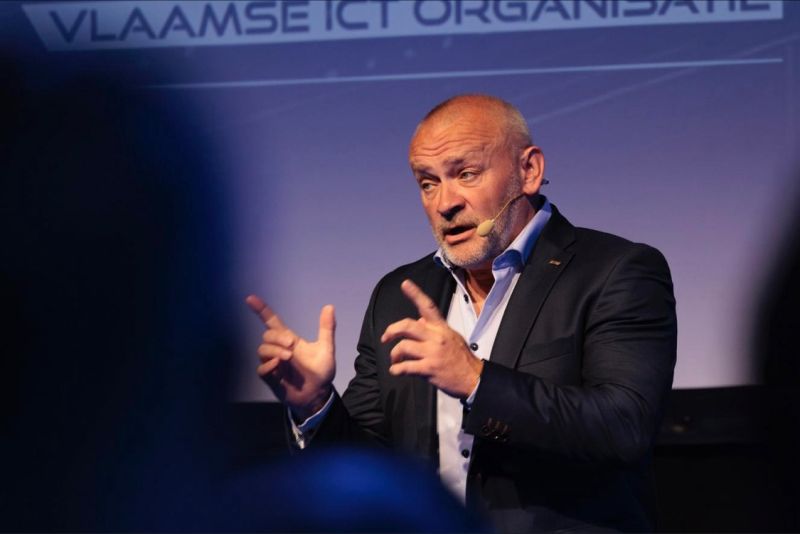
Eddy Van der Stockt is the founder and president of V-ICT-OR.